

What Are Skill Trees?
Skill Trees are one of the core learning concepts in LabEx. A Skill Tree maps a technical topic, such as Linux, Python, Docker, Git, or SQL, into a set of practical skills that you can learn, practice, and prove through hands-on labs. If you are new to LabEx, start with the Quick Start guide first.For a deeper look at the design ideas behind Skill Trees V2, read the technical brief: LabEx Skill Trees V2.
- What skills belong to this area
- Which skills you have already unlocked
- Which skills still need more practice
- How labs and challenges connect to your progress

Designed as Skill Maps, Not Just Course Paths
A Skill Tree is designed as a skill map. It does not simply tell you what lesson comes next. It shows the capabilities that make up a topic and lets your progress grow as you complete real practice. This makes Skill Trees useful even when you learn non-linearly. For example, you may already be comfortable with Linux file operations but still need more practice with services, networking, or process management. The Skill Tree keeps those abilities visible as separate skills.How Skills Are Organized
Each Skill Tree contains a curated set of skills for one technical direction. Every skill is meant to represent a reusable ability, not a tiny command option or a single lab step. For example:- A Linux Skill Tree may include permissions, processes, services, networking, and logs.
- A Python Skill Tree may include data structures, functions, exceptions, modules, files, testing, and type hints.
- A Docker Skill Tree may include containers, images, Dockerfiles, volumes, networks, registries, and Compose.
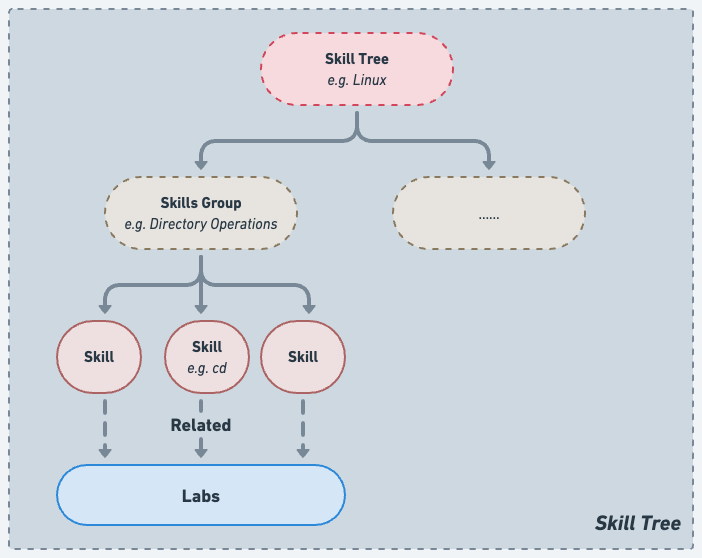
How Labs Unlock Skills
LabEx content is connected to skills behind the scenes. Most labs run inside a LabEx Virtual Machine, and Labby AI can help explain concepts, verify steps, and debug issues while you practice.Guided Labs
Guided Labs teach skills through step-by-step practice in a real LabEx virtual machine.
Challenge Labs
Challenge Labs help verify whether you can apply skills independently.

Why Skill Trees Matter
Skill Trees give your learning journey more structure and feedback:- Clear direction: See the important skills in a topic before choosing what to practice next.
- Measurable progress: Track unlocked skills instead of only counting completed labs.
- Practical focus: Skills are connected to hands-on labs and challenges, not just reading material.
- Flexible learning: You can move across skills based on your background and goals.
- Better recommendations: LabEx can use your skill progress to suggest more relevant learning content.